
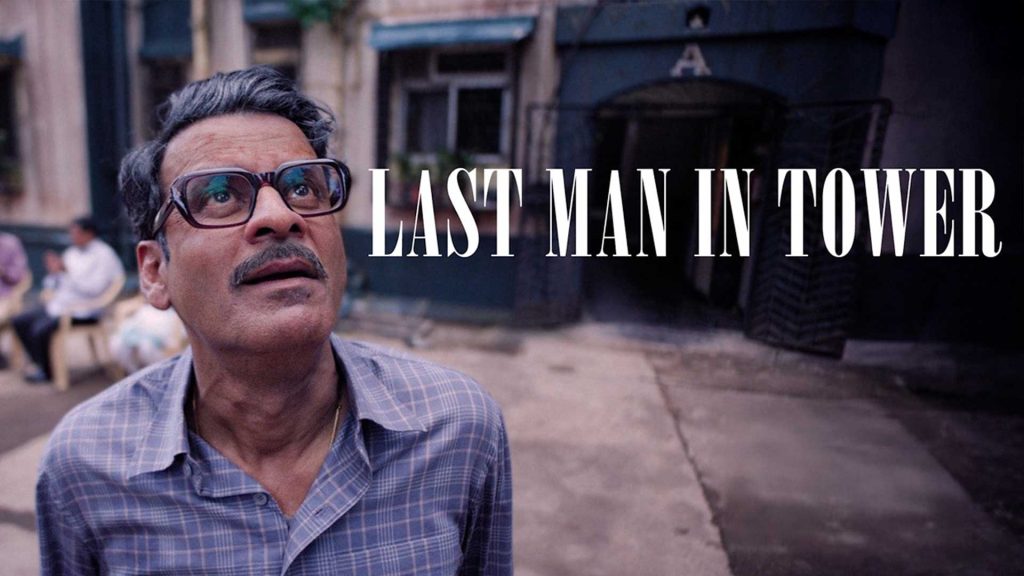

Last Man in Tower review: What would you do if you were offered a huge amount of money for your home, but accepting it meant giving up a place filled with memories? Last Man in Tower explores this difficult question through the story of one Mumbai resident who refuses to sell his house while everyone around him is ready to move on.
Starring Manoj Bajpayee, Divya Dutta and Boman Irani, the film transforms a seemingly ordinary redevelopment dispute into an intense examination of human nature. Adapted from Aravind Adiga’s novel, the movie explores how money can change relationships, friendships and even people’s sense of right and wrong.
A Mumbai housing dispute at the heart of the story
The story revolves around Yogesh Mishra, a retired schoolteacher played by Manoj Bajpayee.
Yogesh lives in an old Mumbai building that holds years of memories, particularly those associated with his late wife. When a builder offers the residents an attractive redevelopment deal, most of them are willing to accept.
Yogesh stands alone.
He believes residents should have the freedom to decide whether they want to leave their homes. For him, the issue isn’t simply about money. His house represents his memories, independence and the life he has built over the years.
But his decision soon creates tension with almost everyone around him.
There are no simple heroes or villains
The film’s writing becomes interesting because it doesn’t portray the residents as greedy people chasing easy money.
Everyone has their own reason for wanting the deal.
Some residents see redevelopment as a chance to provide a better life for their families. Others want financial security, educational opportunities for their children or relief from existing debts.
From their perspective, Yogesh isn’t necessarily defending a noble principle. He is becoming an obstacle standing between them and a chance to change their lives.
This difference in perspective drives much of the film’s tension.
When neighbours become opponents
What begins as a disagreement slowly turns into hostility.
Pressure starts building within the society, and residents who were once neighbours begin treating Yogesh as an enemy. The situation becomes increasingly aggressive, with intimidation and violence entering the picture.
Even people who initially support Yogesh begin questioning whether his stand is worth the consequences.
The film effectively shows how collective pressure can affect an individual’s ability to make an independent choice.
Manoj Bajpayee makes Yogesh deeply human
Manoj Bajpayee is the film’s biggest strength.
Yogesh isn’t written as a perfect protagonist. He can be stubborn, argumentative and overly convinced that his way of thinking is correct.
Bajpayee embraces all those imperfections.
His performance relies heavily on subtle physical details rather than exaggerated acting. His slower movements, expressions and changing body language communicate Yogesh’s age and emotional condition without making the character feel artificial.
There is also a painful loneliness beneath his stubborn personality.
His strained relationship with his son further exposes this side of him. Yogesh wants to remain useful and respected, but his constant advice and rigid attitude have created distance between them.
That contradiction makes him feel like a real person rather than a typical movie hero.
Divya Dutta adds emotional depth
Divya Dutta delivers a strong performance as Sangeeta Puri, a mother dealing with the challenges of raising a special-needs child.
Her relationship with Yogesh makes the central conflict more personal.
Sangeeta tries to convince him to accept the redevelopment proposal, reminding him of how the residents supported him during his wife’s illness. She believes he should now consider the dreams and difficulties of the other families.
Her behaviour can appear manipulative at times, but the performance ensures that she never becomes a one-note character.
Dutta captures Sangeeta’s frustration, vulnerability, anger and desperation with impressive subtlety.
Boman Irani’s builder is more than a typical villain
Boman Irani plays the developer behind the redevelopment project.
Rather than turning the character into an aggressive caricature, the film presents him as composed and persuasive.
His interactions with Yogesh are among the more interesting scenes because the builder seems genuinely curious about why this one man refuses to accept an offer that could change his life.
The question eventually becomes bigger than the property deal: what does Yogesh actually want?
The film deliberately leaves some of that answer open to interpretation.
The society’s gossip reveals another side of Mumbai life
The residential society isn’t merely the setting. It almost feels like another character.
Neighbours constantly observe each other, discuss private matters and pass judgement.
The movie uses these interactions to explore issues beyond redevelopment, including privacy, social expectations and the treatment of people who choose to live differently.
Yogesh’s insistence on personal freedom occasionally puts him at odds with the society’s traditional thinking.
These moments give the film a wider social context and make the story feel connected to everyday urban life.
A different picture of Mumbai
Director Ben Rekhi avoids presenting Mumbai through its familiar glamorous imagery.
Instead, the movie focuses on ageing buildings, cramped apartments, neighbourhood conversations and the slow transformation of old residential areas.
The contrast between the existing building and the promise of redevelopment becomes symbolic.
For some residents, the old building is a burden that should be left behind. For Yogesh, it is a part of his identity and history.
That difference is what ultimately drives the conflict.
The film asks difficult questions
As Yogesh becomes increasingly isolated, the movie refuses to tell viewers exactly how they should judge him.
Is he courageous for refusing to surrender his principles?
Or has his determination gone too far?
Similarly, are the other residents greedy for wanting the money, or are they simply trying to improve their families’ lives?
There are no easy answers, and that ambiguity is one of the film’s strongest qualities.
Is Last Man in Tower worth watching?
At around 97 minutes, Last Man in Tower is relatively compact and maintains a steady pace.
The film works best as a character-driven drama rather than a conventional thriller. Its strongest moments come from the performances and the gradual deterioration of relationships inside the housing society.
Manoj Bajpayee delivers an exceptionally layered performance, while Divya Dutta provides the emotional counterpoint. Boman Irani adds another interesting dimension to the redevelopment conflict.
The film’s conclusion is emotionally heavy and leaves the audience thinking about the cost of both compromise and resistance.
Last Man in Tower Review: Final Verdict
Last Man in Tower takes a simple Mumbai redevelopment dispute and turns it into a broader story about money, memory, loneliness, family and human behaviour.
It doesn’t ask viewers to blindly support Yogesh or condemn the residents. Instead, it makes us understand why different people make different choices when their homes and futures are at stake.
Verdict: A thoughtful and emotionally engaging drama powered by excellent performances.
Rating: 4/5

