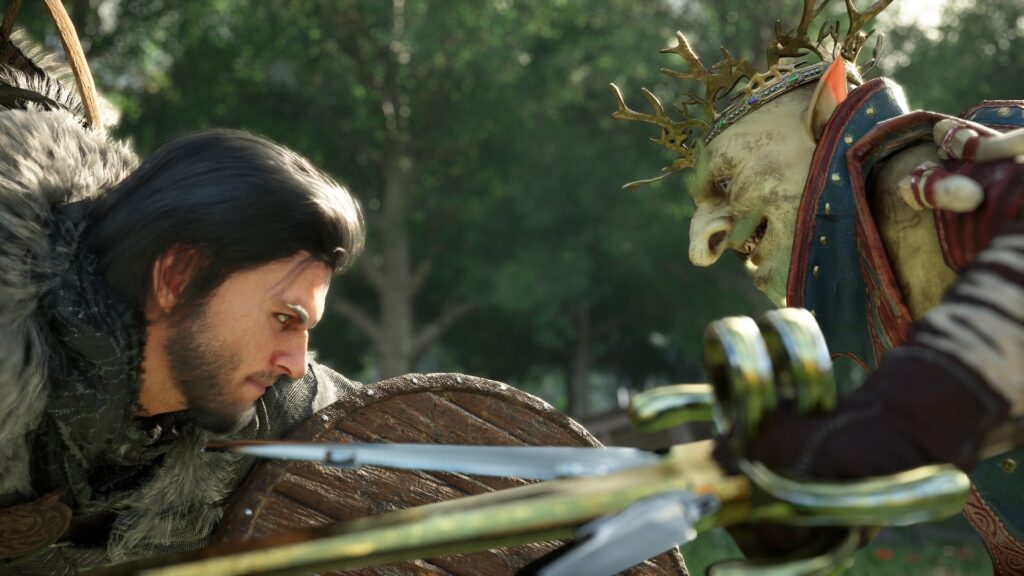

Crimson Desert is one of the biggest single‑player action‑RPGs of 2026, delivering a war‑torn fantasy world packed with exploration, flashy combat, and hundreds of hours of content. From its sweeping deserts to sky‑borne ruins, the game feels like a blockbuster‑style sandbox built for players who love to roam, fight, and experiment. But beneath that polished exterior lies a game that can feel bloated, repetitive, and uneven in pacing.
A war‑torn fantasy sandbox
Set in the fractured realm of Pywel, Crimson Desert casts you as a mercenary surviving in a land torn between warring factions, ancient curses, and looming cosmic threats. The world feels like a mix of gritty medieval realism and high‑fantasy spectacle, with cities that look like crumbling medieval strongholds, villages buried in sand, and citadels clinging to the sides of massive cliffs.
The map is enormous, filled with deserts, snowfields, jungles, and ruined fortresses. You’re constantly invited to climb, jump, and explore just to see what’s over the next hill, and the game rewards that curiosity with hidden caves, enemy camps, and small side scenarios that don’t always show up as glowing icons.
Exploration and world design
Exploration is Crimson Desert’s strongest pull. The game wants you to wander, not just follow the main quest line. You’ll find hidden arenas, underground ruins, and “Abyss Islands” that spiral up into the sky and challenge you with boss‑like fights or gauntlet‑style runs. Climbing, gliding, and grappling hooks let you reshape how you travel, turning the environment into a vertical playground.
The lighting and weather systems add to the immersion. Sandstorms sweep across the dunes, fog clings to the ruins, and distant storms roll over the horizon, all while the camera lingers on long, cinematic vistas. For players who enjoy lose‑yourself‑in‑the‑world experiences, the setting alone is enough to pull you in for dozens of hours.
Combat that swings big
Crimson Desert’s combat is fast, flashy, and highly customizable. You can chain light and heavy attacks, dodge, parry, and use a grappling hook to yank enemies toward you or swing yourself around the battlefield. Air‑dashing, gliding, and wall‑jumps keep you mobile, letting you stay on the offensive while dodging incoming attacks.
Later in the game, you unlock heavier tools: mechs, mounted combat, and even dragon‑riding, turning certain fights into spectacle‑heavy set‑pieces. When everything clicks—perfect dodges, cinematic counters, and fluid movement—combat feels incredibly satisfying. For players who enjoy mastering combos and timing, the fight system is one of the game’s best features.
Story, pacing, and missions
The story follows the classic mercenary‑in‑a‑dying‑age structure: you take jobs, uncover secrets, and slowly get pulled into a larger conflict that threatens the world. The premise is solid, but most players and reviewers agree that the writing and characters don’t match the ambition. Dialogue can feel generic, and the emotional beats often fall flat, making the narrative feel more like background flavor than a main draw.
Mission design leans heavily on the open‑world RPG formula: kill X enemies, collect Y items, explore Z locations. By the time you’re 80–100 hours in, a lot of side content starts to loop back on itself, which can cause fatigue. The world feels rich, but the storytelling doesn’t always keep up.
Progression, systems, and grind
Crimson Desert throws a lot of systems at you. You’ll unlock multiple skill trees, armor layers, weapon types, and support mechanics that let you build from a nimble acrobat to a tanky bruiser. Faction‑based perks, crafting, ranching, and farming add long‑term progression, letting you cook buffs, craft gear, and slowly shape your playstyle.
The downside is the grind. Completing everything can easily run past 150–200 hours, and by the mid‑game, many side quests feel like filler. The content is generous, but it can feel bloated if you don’t care about maxing out every stat and collecting every item.
Camera, controls, and polish
The camera and controls are one of the game’s more divisive aspects. Crimson Desert leans into a cinematic, over‑the‑shoulder style that swings and swerves during combat, which looks great in trailers but can feel disorienting in actual play. Dodging and blocking in tight spaces becomes harder because the camera doesn’t always frame the action clearly.
There are also some bugs, occasional performance dips, and clunky UI choices that break immersion. On powerful PCs and current‑gen consoles, much of this is manageable after patches, but players who dislike losing control or dealing with camera‑heavy action should try a demo first.
Who should play Crimson Desert?
Crimson Desert is best for:
- Players who love massive open‑world RPGs with 100+ hours of content and endless exploration.
- Fans of action‑RPGs and stylish combat who enjoy experimenting with different builds and flashy moveset combos.
- People who want a premium, single‑player experience with MMO‑style depth but without the live‑service grind.
It’s less ideal for:
- Players who want a tight, story‑focused RPG with a strong narrative and memorable characters.
- Anyone who dislikes grind, repetitive missions, or camera‑heavy combat design.
If you’re someone who enjoys getting lost in a huge world, tinkering with builds, and spending months in a single RPG, Crimson Desert has a lot to offer. If you prefer shorter, more polished experiences with a stronger story spine, it might be better to watch a full playthrough or sample it through a time‑limited trial first.