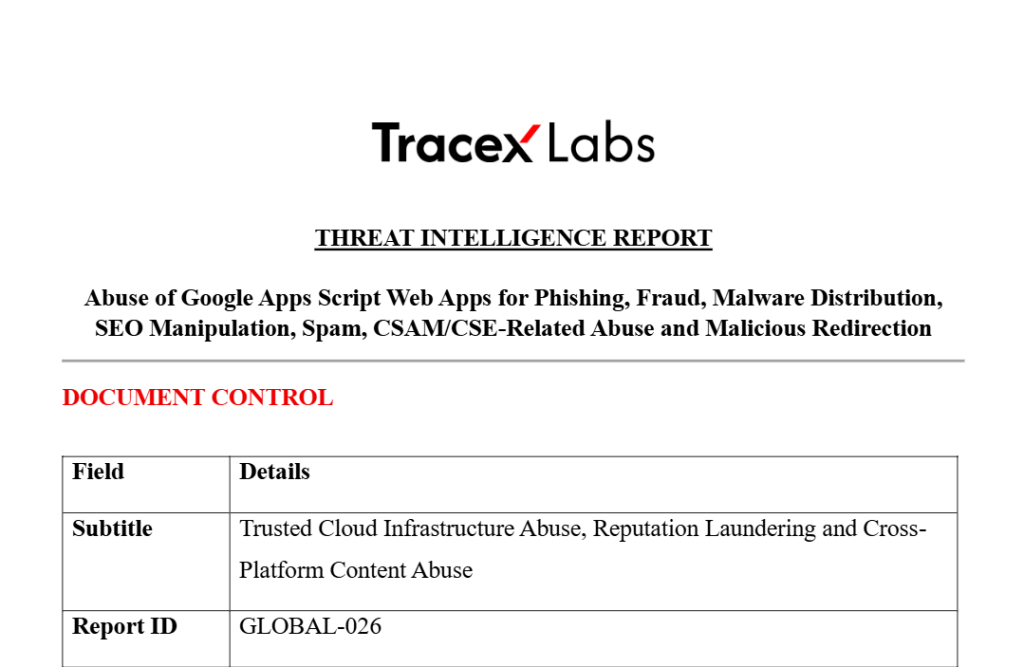

Google Apps Script is facing fresh scrutiny from cybersecurity researchers after TraceX Labs identified its Web Apps functionality as a potential component in phishing, fraud, malware and search-manipulation campaigns.
Cloud services have become an important part of modern online infrastructure, but their widespread availability can also create opportunities for misuse. A new report from TraceX Labs examines how Google Apps Script Web Apps can potentially be incorporated into campaigns designed to deceive users, distribute unwanted content or redirect visitors to external websites.
The report was released on September 30, 2026, under the title “Abuse of Google Apps Script Web Apps for Phishing, Fraud, Malware Distribution, SEO Manipulation, Spam, CSAM/CSE-Related Abuse and Malicious Redirection.”
TraceX Labs identifies the research as GLOBAL-026 and gives it a high threat assessment.
Legitimate technology being used in unexpected ways
Google Apps Script is primarily a productivity and automation platform. It allows developers to create scripts and Web Apps that can interact with Google services, process requests and generate web content.
TraceX Labs says those capabilities can sometimes become part of a larger abuse chain.
For example, an attacker may distribute an Apps Script URL through an email, social network, messaging platform or search result. The visitor may then be redirected to another website or resource.
The researchers emphasize that this should not be interpreted as evidence that Google Apps Script itself is malicious.
Phishing and financial scams are among the reported concerns
The report covers several types of online deception, including credential phishing, investment scams, employment-related fraud, fake payment schemes and social-engineering campaigns.
Apps Script Web Apps may serve as an intermediate page or landing point during some of these operations.
This makes the final destination particularly important when investigating an incident. Researchers may need to examine the complete redirect chain and identify the domains, files or services involved after the initial Apps Script URL.
The report also discusses potential Android APK and malware distribution cases. TraceX Labs says malware claims should be supported by technical evidence or established reputation information.
Search manipulation adds another layer
Cybersecurity researchers are also paying attention to the role of suspicious web infrastructure in SEO abuse.
TraceX Labs points to several patterns that can indicate the need for further investigation, including:
- Automatically generated pages
- Keyword-heavy content
- Doorway pages
- Repeated page templates
- Large numbers of outbound links
- Suspicious redirect chains
When infrastructure is deliberately used to influence search visibility, the activity may potentially relate to MITRE ATT&CK’s T1608.006 SEO Poisoning technique.
However, the report recommends avoiding conclusions based on a single indicator. The surrounding infrastructure and actual behaviour should also be examined.
Different types of spam are covered
The research goes beyond phishing and SEO.
TraceX Labs also discusses gambling and betting spam, adult and NSFW material, drug-related spam, deepfake and synthetic-media campaigns, video and search spam, and movie-piracy-related search activity.
The researchers point out that the appearance of certain keywords does not automatically establish malicious intent.
Additional evidence is needed to understand whether a page is part of an organized abuse campaign or simply contains content associated with a particular topic.
Report makes distinction in suspected CSAM cases
TraceX Labs also examines infrastructure that it describes as suspected CSAM/CSE-related activity.
The report uses the classification “Suspected / Corroboration Required,” indicating that the finding requires further evidence.
Because of the nature of such investigations, the report recommends careful evidence handling and specifically cautions against unnecessary downloading or redistribution of suspected illegal material.
Why investigators should look beyond the Google URL
A key message from the research is that the reputation of a major technology company cannot automatically determine whether an individual resource is safe.
A Google-owned URL does not necessarily mean that Google created the page, controls an external website linked from it or approves the content being delivered.
Likewise, HTTPS only provides encrypted communication between the browser and server. It does not independently verify the legitimacy of a website.
For investigators, the behaviour surrounding the URL can therefore be more valuable than the domain’s reputation.
Security teams can examine multiple indicators
TraceX Labs recommends correlating Apps Script activity with other technical information during investigations.
Security teams can examine:
URL parameters: Unusual or campaign-specific parameters may provide useful clues.
Redirects: Following the chain can reveal the final destination and additional infrastructure.
Domains and IP addresses: Related infrastructure may connect multiple incidents.
Certificates and ASNs: These can provide additional information about hosting and infrastructure relationships.
File hashes: Downloaded files can be investigated against known threat intelligence.
Network monitoring can also help identify unexpected downloads and suspicious browsing behaviour.
A structured investigation can reduce false conclusions
TraceX Labs proposes the following process for investigating suspicious infrastructure:
Discover → Validate → Correlate → Classify → Report
The report uses classifications such as Observed, Correlated, Suspected, Potential, Benign and Unknown.
This approach is intended to prevent investigators from treating limited evidence as definitive proof.
TraceX Labs specifically notes that a single URL, screenshot or infrastructure component does not automatically prove attribution, ownership, criminal intent or an affiliation with Google.
What organizations should take away
The report highlights a broader security challenge facing organizations that rely heavily on cloud services.
Legitimate infrastructure can potentially appear in malicious campaigns without the service itself being malicious. Consequently, security teams may need to investigate the activity surrounding a URL rather than blocking an entire platform based solely on its reputation.
For businesses and security researchers, examining redirect behaviour, destination domains, downloaded files and related infrastructure can provide a more complete picture.
TraceX Labs says its full report contains additional technical findings, detection guidance and investigation recommendations for SOC teams, CERTs, cybersecurity researchers and law-enforcement organizations.
Read Full Report: https://tracexlabs.com/reports/google-apps-script-abuse-threat-report-2026.html