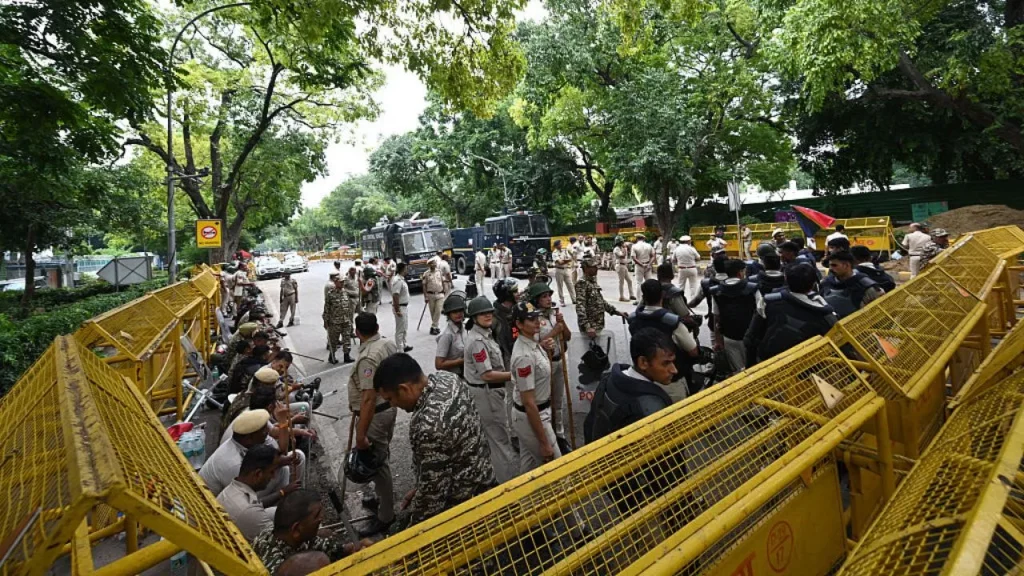

The Supreme Court has set up a five-member High-Powered Expert Committee (HPEC) to investigate allegations of excessive use of force by police, paramilitary forces and other security personnel against people protesting over the alleged NEET paper leak.
The committee will examine the police response to peaceful demonstrations held at Jantar Mantar in Delhi and in other parts of the country.
Justice R Subhash Reddy to Head Panel
A three-judge bench headed by Chief Justice of India Surya Kant, along with Justices Joymalya Bagchi and V. Mohana, announced the formation of the committee on Thursday.
The panel will be headed by former Supreme Court judge Justice R. Subhash Reddy.
Other members of the committee are:
- Former Punjab and Haryana High Court Chief Justice Ravi Shankar Jha
- Former Delhi High Court judge Justice Shalinder Kaur
- Former CBI Director Rishi Kumar Shukla
- Retired Meghalaya DGP L.R. Bishnoi
The Supreme Court said the members were selected after considering their individual expertise, experience and the overall diversity of the panel.
Probe to Cover Alleged Excessive Force
The committee has been asked to examine allegations involving the use of excessive or disproportionate force during protests.
The inquiry will cover allegations relating to lathi-charges, tear gas, electric batons and pellet guns, among other forms of crowd-control measures.
The panel will also examine whether the use of metallic pellets fired from pump-action rifles or similar weapons should be prohibited, particularly because of concerns over serious and permanent injuries.
Harassment of Women Protesters Gets Priority
The Supreme Court has specifically directed the committee to give priority to allegations of harassment and molestation involving protesters, particularly women.
The panel will also look into reports of serious injuries suffered by protesters during police action.
The court said its objective is to examine how authorities can maintain public order during demonstrations while also protecting the constitutional right of citizens to assemble and protest peacefully.
CCTV, Drone and Body-Cam Footage to Be Preserved
To protect evidence, the Supreme Court has ordered authorities to preserve relevant CCTV recordings, drone footage, body-camera recordings and PCR call records connected with the protests.
The preservation of these records is intended to help establish an independent timeline of events and prevent important evidence from being altered or lost.
Court Seeks Periodic Findings
The Supreme Court clarified that the committee’s work will not be limited to a single inquiry.
It directed the HPEC to conduct a continuous and periodic assessment of the issues and submit interim findings from time to time.
The court said the committee’s recommendations could assist it in reaching a comprehensive assessment of the allegations and broader issues surrounding police action during protests.
Detained Minors and Protesters’ Privacy
The court also reiterated its earlier direction regarding the release of detained minors, except in cases involving allegations of serious and heinous offences.
At the same time, it stressed the need to protect protesters’ personal information. Police authorities have been restrained from publicly disclosing private details of protesters, with directions to safeguard such data.
Police Officers Can Face Independent Action
The Supreme Court made it clear that departmental proceedings against police personnel do not have to wait for the committee’s final findings.
Competent authorities can independently initiate departmental action if there are grounds to do so.
The committee will also investigate allegations that protesters were subjected to surveillance or monitoring and assess whether such actions were consistent with their constitutional rights to privacy and peaceful assembly.
Focus on Accountability During Protests
Another issue before the committee will be whether police and security personnel involved in arrests or crowd-control operations should be required to wear uniforms and clearly visible nameplates.
The measure could help establish the identity of officers involved in enforcement operations and strengthen accountability.
The Supreme Court’s decision puts the conduct of security forces during the NEET-related protests under detailed scrutiny, while also opening a broader examination of how authorities should balance public order with citizens’ fundamental right to peaceful protest.